


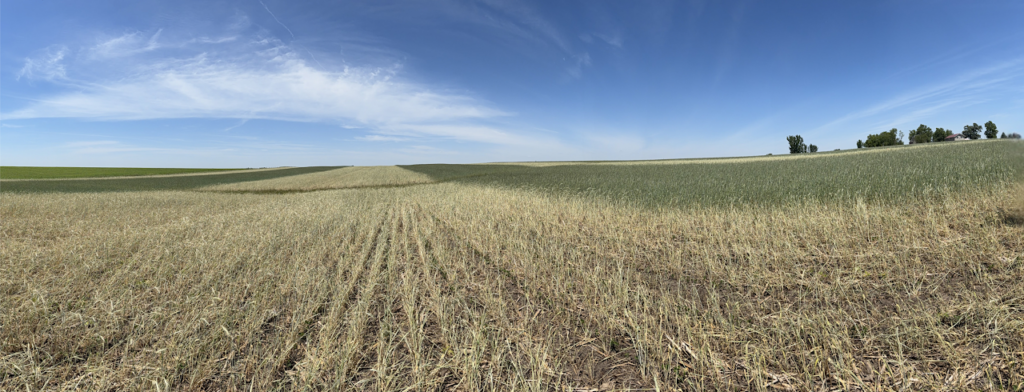
Farms and agricultural land cover hundreds of millions of acres across the United States, making them one of the most powerful levers for managing flooding. When farmers adopt practices that slow runoff, increase soil infiltration, and store water, they protect their own fields while serving as critical flood infrastructure for entire watersheds. But right now, we are not harnessing the full potential of this powerful nature-based solution.
As we’ve written previously, flood-smart agriculture — farming and land management practices that reduce flood risk, improve the land’s ability to absorb water, and deliver watershed benefits to farms, communities, and populations downstream — has the potential to change that. Wider adoption of flood-smart agriculture could be transformative in addressing flood risk for farmers and downstream communities alike. The American Flood Coalition (AFC) supported research in Iowa that found that wider use of multi-cropping upstream in the Cedar River Watershed could reduce flooding by up to 30%.
These practices and their benefits are well established. What’s missing is the coordination, data infrastructure, incentives to deploy these practices at scale, and the resources to ensure success. To address that gap, we have developed four practical state and federal policy proposals that would equip farmers and decision makers to better harness flood-smart agriculture to reduce flooding on farmland and throughout watersheds. These proposals are designed to work together. Farmers need the right incentives to act, but those incentives require verifiable outcomes, which necessitates data. That data demands coordinated infrastructure and strategic planning. And coordination needs dedicated funding.
#1 Reward farmers for flood risk reduction outcomes
Right now, most conservation programs pay farmers for activities like planting cover crops, rather than outcomes like increasing groundwater storage capacity. Farmers that produce are not rewarded when outcomes are met, nor recognized for exceptional results.
When farmers have a financial stake in outcomes, they’re more motivated to go above and beyond, and watershed planners can actually trust that progress is being made. A smarter approach would reward farmers both for adopting flood-smart practices and for delivering measurable flood reduction. This “pay-for-performance” model already exists for improving water quality and soil health. Applying it to flood risk is a natural next step.
#2 Establish Flood-Smart Agriculture Centers to anchor farmland flood reduction
Flood-smart agriculture works at a watershed scale when it’s done strategically — the right practices need to go in the right places. Knowing where to focus requires good data. Many states already collect some of it using farm sensors, stream gauges, and conservation monitoring, but this information is rarely pulled together to specifically understand and address flooding on agricultural land.
States could close this gap by establishing Flood-Smart Agriculture Centers focused exclusively on agriculture and flooding. Sitting at the intersection of hydrology, land management, and public decision-making, these centers would identify which practices have the biggest flood-reduction impact, verify that outcomes are being achieved, and give farmers, counties, and communities the technical support they need to act.
#3 Empower watershed governance entities to drive adoption of flood-smart agriculture
Individual farmers can adopt flood-smart practices, but protecting an entire watershed requires coordination across dozens — sometimes hundreds — of farms, landowners, and local jurisdictions. That kind of strategic planning requires someone to take charge.
Most states already have regional organizations, such as conservation districts and councils of government, that could take on this role. To do so, they need a clear mandate and dedicated resources to make flood management an explicit part of their mission. With that direction, these organizations could help create and maintain flood infrastructure, like stream gauges and sensors, prioritize and collaborate on project implementation, and connect farm-level practices to watershed goals. The result would be resilience that benefits entire watersheds, both upstream and downstream communities alike, rather than just specific areas.
#4 Dedicate federal funding to watershed flood risk governance
Flood risk is a national problem, and the federal government has a direct interest in addressing it. Better coordination and planning of flood mitigation strategies and projects can maximize limited resources and reduce the up-front costs for protecting lives and property. Likewise, if flood risk is addressed more effectively and efficiently, it would spare hardship and losses for people and communities.
The federal government should therefore provide dedicated funding to support proactive watershed flood risk reduction efforts in every state. Federal funding would help states close gaps in their watershed management budgets and give watershed organizations the resources they actually need to function and not just exist on paper. The goal is a system where federal dollars amplify state and local efforts, rather than duplicate them.
Tying it all together
Farmers want to be part of the solution. States and communities want healthier watersheds and better flood protection. What’s been missing is the policy framework to connect these goals. Our four proposals link those goals into a durable, interconnected system that rewards farmers for stewardship, generates verifiable outcomes, and supports watersheds that are safer and more resilient.
To learn more about our flood-smart agriculture work and how AFC is advancing these policies, visit our flood-smart agriculture page.