

Defense Access Roads Amendment Signed Into Law

Program amendment has become law with the signing of the 2019 National Defense Authorization Act
 

The Fiscal Year 2019 National Defense Authorization Act (NDAA) was signed today, and with that we are excited to announce that Representative Scott Taylor (VA) has led the way for the Defense Access Roads (DAR) program amendment we have been working on to sail through Congress and become law!

One of our top priorities has been protecting our military bases from sea level rise and flooding, and today marks a big step in that direction.

DAR is a small Department of Defense program that allows military installations and defense industry sites to use their yearly funding to address transportation issues on roads leading into or out of their location.
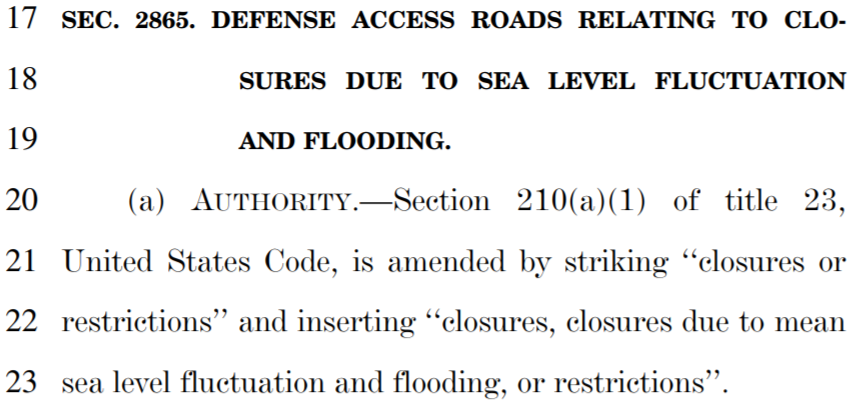
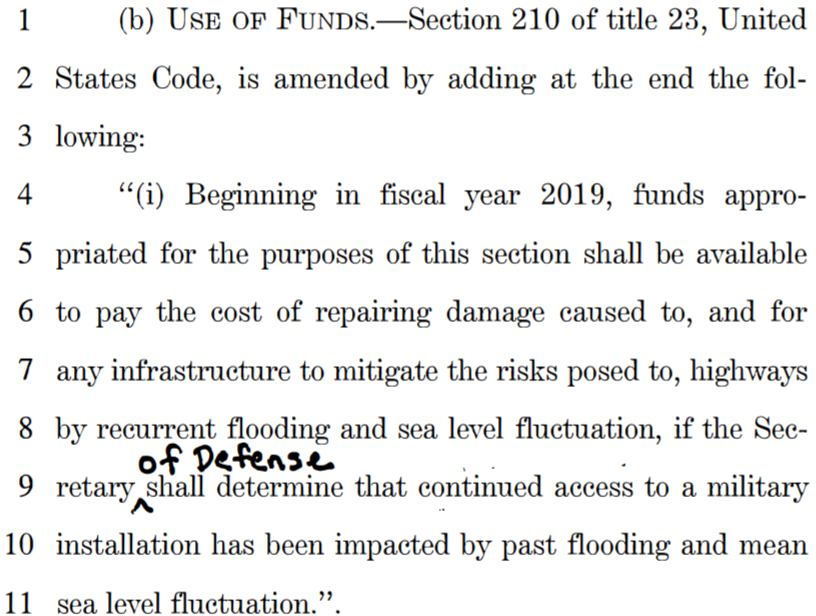
The amendment text, complete with last-minute edits.

While speaking to our members that either worked or lived on or around military bases, they all spoke about the same problem:

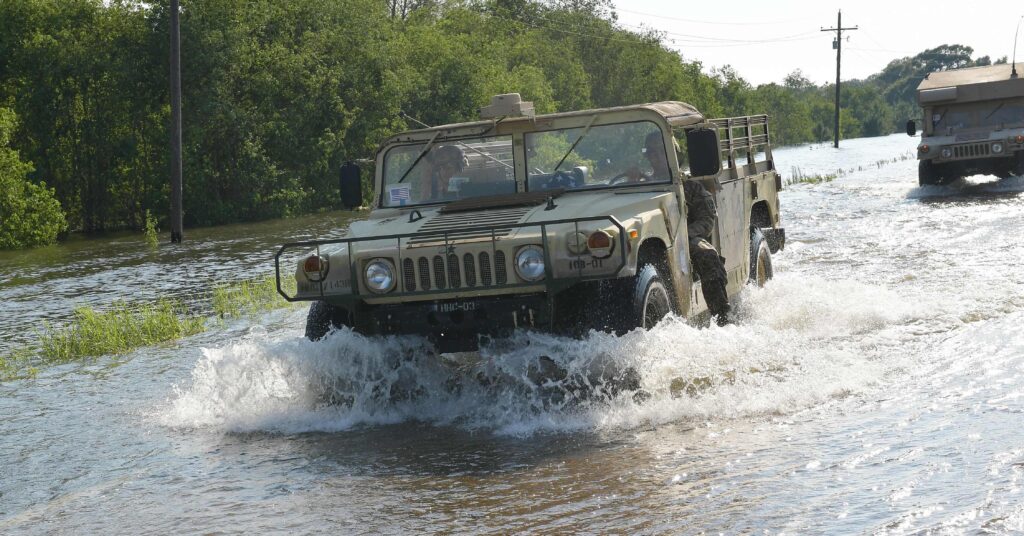
Flooded roads frequently prevented them from reaching the base, but there was no reasonable way to fix the issue.

Flood risk management would typically be an Army Corps Civil Works issue, but they require a significant non-federal cost share that no city was able to easily afford. Since the base itself couldn’t do anything due to DAR’s restrictive program criteria, the problems were left unaddressed with no solutions.

We knew that fixing this issue was a project that we had to take on.

With Rep. Taylor leading the effort, and support from other Members of Congress who recognize the need to preserve our military readiness, we were able to get through the House with bipartisan support for new report language in the Military Construction and Veterans Affairs Appropriations bill, and an amendment to the DAR program in the NDAA.

This was a small victory, but getting through the House was only the first step towards our ultimate goal. Going back to work on the Hill, we continued to engage Members and staffers to try and maintain the momentum and get DAR across the finish line. The remaining steps — support in the Senate, making it into the Conference Report — were going to be difficult. But thanks to our efforts, our friends in Congress, and strong support from stakeholders in flood-affected regions, we were able to make it happen.

The signing today is an important moment for the Coalition. It shows in no uncertain terms how effective we can be when we listen to the needs of our membership and drive for efficient reforms.

In the span of about four months, we were able to take an idea and make it reality. We have achieved a significant milestone in our pursuit of protecting our military and the communities that surround and support their bases. Our ability to accomplish so much in such a short period of time speaks to the power of bipartisanship in Congress, and we cannot thank them enough for their cohesive efforts on this.

As we move into the second half of the year, we’ll continue to push for additional reforms that benefit our membership. We’ve got our eyes on some short, intermediate, and long-term goals, and we’ll keep you updated every step of the way!

As always, if you have any questions or comments on our policy agenda, let us know! Contact us through social, or email us at info@floodcoalition.org.

Facebook
X
LinkedIn

Recent News

One year after Helene: Western North Carolina leaders highlight ongoing need for resources

The Carolinas and Florida advance flood resilience during sessions

Building resilience with flood-smart agriculture

Join Our Newsletter

Name(Required)

Help Me Choose

Which characteristics is your community looking for in funding opportunities?

Disaster declaration
A Presidential Disaster Declaration unlocks a suite of federal programs that assist local governments with disaster recovery. This is a good filter for communities included in recent Disaster Declarations related to flooding.
Nature-based solutions
The program has a strong focus on providing assistance to promote a healthy ecosystem as a critical defense against flooding impacts. Eligible activities may include floodplain restoration, environmental stewardship, projects that use natural features to mitigate erosion, and living shorelines.
Encourages public-private partnerships
The program encourages or requires collaboration between government entities and stakeholders, including the private sector, to fund, develop, or implement projects.
Offers rolling deadlines
The program accepts applications on an ongoing basis with no fixed deadline.

Is your project in the planning, design, or construction phase?

Planning
The gathering of data and information regarding the extent and impacts of flooding. Eligible activities may include data acquisition, risk assessment, and environmental analysis.
Design & scoping
Covers pre-construction activities, such as defining project scope, developing technical designs, and securing funding to prepare for implementation.
Construction & implementation
Involves carrying out flood resilience projects, including building infrastructure and deploying solutions to reduce flood risks.

Are you looking for grants, loans, or technical assistance for your project?

Funding (grants)
A monetary award that does not need to be repaid. Many federal grants are reimbursable, meaning recipients must cover project costs upfront and then request reimbursement from the government.
Financing (loans)
A government-issued loan that must be repaid. These loans typically provide funding upfront, helping communities cover project costs before repayment begins.
Technical assistance
Assistance from the government in the form of services — such as project planning, engineering and design support, data analysis, training, capacity building, or collaboration through a cooperative agreement — instead of direct funding.

Some programs provide extra support for specific project types or communities. Do any of these apply to your project?

Small or rural communities
Programs that set aside funding, offer loan forgiveness, or adjust cost share requirements for communities with smaller populations.
Small or low-cost projects
Programs that offer reduced requirements for smaller projects, such as waived cost-sharing or exemptions from benefit-cost analysis.
Regional or watershed focus
Programs that support projects that take a watershed management approach or address flooding at a regional scale, requiring coordination beyond a single town or community.
Tribal communities
Programs that dedicate resources or adjust cost share requirements specifically for tribal governments or organizations.