


Agriculture is the backbone of rural America and a lifeline that feeds the world. With one in five Americans living in rural areas and nearly half the country’s land used for farming, farmers and other agricultural producers make important decisions every day that shape the health and resilience of entire regions.
This is particularly important when it comes to floods, which is why flood-smart agriculture — farming and land management practices that improve soil health and manage water to increase flood resilience — is so essential.
Flooding can ruin crops for multiple seasons, damage soil health, and upend harvesting time. And the water that falls on farmland doesn’t stop there, it can lead to flooding downstream. Addressing flooding on agricultural land is not only critical to our nation’s safety, but also one of our greatest opportunities to reduce flooding across entire watersheds and communities nationwide.
That’s why the American Flood Coalition believes that agriculture policy is flood policy: When policy encourages farmers to manage their lands to absorb water and slow runoff, it doesn’t just benefit individual farms, it protects entire watersheds and downstream communities from devastating floods.
As the only organization working at the intersection of flooding and agriculture, AFC is uniquely positioned to advance efforts in this space. We combine strong relationships with farmers, hundreds of local leaders, state officials, and federal policymakers with a proven ability to launch, test, and scale solutions that reduce flood risk in agricultural lands, and therefore downstream communities, across the country.
Reducing flooding at the watershed scale
The size and features of a watershed help determine how much water is in a given area and how that water moves. Rural areas are often upstream within watersheds, so flood management decisions made by upstream communities directly affect towns and cities downstream. We can use this knowledge to inform land-use planning and agricultural decisions to better manage floods, reduce risk, and transform flood management within a watershed.
To accomplish this, towns and cities downstream must work collaboratively with communities and producers upstream. By working together and approaching solutions at the watershed level, these communities can find solutions that benefit everyone, rather than working in siloes.
AFC’s first-of-its-kind multi-cropping watershed research, conducted in partnership with Iowa State University, is a prime example. We found that with wider use upstream, multi-cropping, when farmers plant multiple crops during the same growing season in one field, could reduce flooding in Iowa’s Cedar River Watershed by up to 30%. This could have saved 500 homes and businesses from flooding during Cedar Rapids’ devastating 2016 floods.
AFC has also invested in pilots on the ground in Iowa to research farmer-led flood solutions. We conducted the first work to measure the flood reduction benefits of multi-cropping with two pilot sites in Guthrie Center and West Union, Iowa. By partnering with farmers and local partners, including the Iowa Flood Center and Northeast Iowa Resource and Conservation and Development, we found that multi-cropping reduces flooding on farms, boosts profits by $50.90 per acre, and improves soil health and water quality.
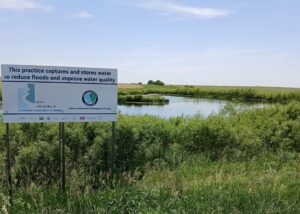
The city of Cedar Rapids, Iowa, through the Middle Cedar Partnership Project, worked with farmers upstream to improve water quality and reduce flooding. The city provided farmers with financial and technical assistance to use flood-smart agricultural practices like cover crops and wetlands. These practices helped farmers improve soil health and reduce runoff, while helping the city protect its drinking water supply.
This collaboration shows how a watershed approach can protect both rural and urban areas from flooding, offering a cost-effective way to manage risk while proving that everyone benefits when they work together.
AFC’s pilot projects and watershed research build on this by demonstrating the measurable flood reduction benefits of agricultural practices and providing clear pathways to scale them to the state and federal levels.
Scaling solutions through state and federal policy
As a coalition that works with leaders at all levels, AFC has a unique ability to elevate tested solutions and local perspectives to state and federal decision makers. This matters because federal and state governments play distinct but complementary roles in advancing flood resilience.
USDA provides the lion’s share of federal technical and financial assistance for farmers and rural communities to recover from disasters, adopt flood-smart conservation practices, and pursue watershed-scale solutions. Meanwhile, states are the linchpin for administering and directing resources toward local priorities. While there is no one-size-fits-all approach, states can support farmers with the resources and incentives to drive locally led, high-impact flood solutions. That’s why AFC is working to ensure that federal programs, like those Congress considers every five years as part of the Farm Bill, prioritize flooding and incentivize innovative, farmer-led solutions like multi-cropping.
With a watershed-scale approach to flooding, combined with support at all levels of government, upstream farmers and downstream communities are empowered to work together on innovative agricultural solutions to protect against flooding.
Looking ahead, AFC is deepening our work on the ground with agricultural communities and producers to scale flood-smart agriculture solutions that can address our nation’s flooding challenges. We’re building connections with farmers and resilience leaders from different states, geographies, and ways of farming so that we can advance flood-smart agriculture policies and empower farmers to lead on innovative solutions.