

May 18, 2022
—
Across the country, states are feeling the impacts of increased flooding. Since 2020, there have been 17 presidentially declared flood disasters across 12 states and Puerto Rico. While states have plans that often summarize a state’s flood resilience activities and capabilities, many states stop short of putting these plans into action.
That was the finding of a new report by the Urban Institute, which was commissioned by the State Resilience Partnership — a partnership of organizations convened by the American Flood Coalition and the Pew Charitable Trusts. This first-of-its-kind research on statewide resilience and adaptation planning found that flood planning is largely underdeveloped at the state level.
To improve ways state resilience plans can lead to on-the-ground outcomes, AFC built upon this analysis to identify five recommendations for state planners. This blog post will explore these five recommendations to help planners turn state resilience plans into actionable strategies.
5 ways to improve state resilience plans
States are essential for reducing flood risk. They are important links between federal agencies and local governments, coordinating post-disaster responses and deciding how to spend money on flood projects. And they are well positioned to organize watershed-level approaches to flood planning, as they can more easily look across local jurisdictional boundaries.
But without effective statewide planning, federal funds go unspent and local governments’ flood priorities are neglected. To fully take advantage of their unique role in flood planning and ensure communities across the state are better prepared for flooding, state planners should do the following:
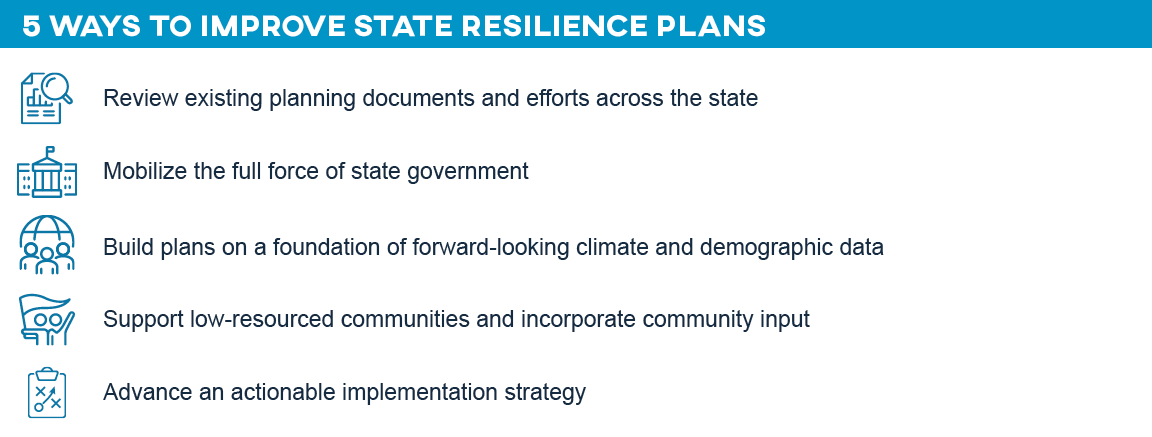
1. Review existing planning documents and efforts across the state
To better prepare for flooding, state planners should first identify the plans that address flooding in their state and who is responsible for development and implementation. The report finds that, on average, states have two to three plans that address flood resilience and adaptation.
These plans can include the State Hazard Mitigation Plan, as well as any applicable flood, coastal, climate, water, resilience, and emergency management plans. Planners should review all these to understand all those involved in flood planning at the state level, including departments, agencies, offices, and non-governmental stakeholders.
2. Mobilize the full force of state government
State flood planning is often spread across multiple plans and offices. This siloed approach can lead to different — and sometimes competing — timelines, objectives, and risk projections that fail to account for a state’s full flood risk.
To break down these barriers states should establish a central source for strategic flood planning with consistent values, goals, and metrics to use across all state efforts. A centralized model can help identify dedicated funds for flood planning and related efforts like continual data collection and risk assessments.
3. Build plans on a foundation of forward-looking climate and demographic data
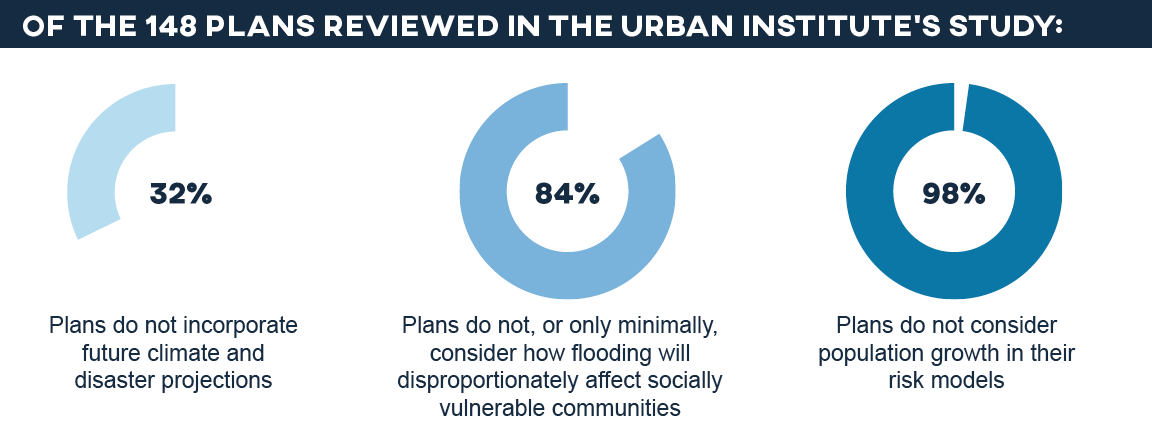
When flood risk models are based on historic trends, they fail to provide a true view of a state’s current and future risk. Of the 148 plans reviewed in the Urban Institute’s study…
- 32% do not incorporate future climate and disaster projections.
- 84% of plans do not, or only minimally, consider how flooding will disproportionately affect socially vulnerable communities.
- 98% of plans did not consider population growth in their risk models.
Because of discriminatory land-use and housing policies, socially vulnerable communities are often located in floodprone areas. Without including data on social vulnerabilities in their risk assessments, states will see disproportionate and inequitable outcomes when flooding occurs.
State flood resilience plans should be built on a foundation of forward-looking data that includes climate projections, population growth, and locations of socially vulnerable communities. Planners should set metrics around whether socially vulnerable communities are meaningfully engaged, included in risk analyses, and have their needs met.
To support local jurisdictions, state planners should increase access to data resources at the state and local level, including through technical assistance staff and engineers. This will help jurisdictions who may lack the capacity to conduct time- and cost-intensive risk assessments and planning on their own.
4. Support low-resourced communities and incorporate community input
States lean on local governments to carry out state flood plans; however, the Urban Institute report found that few state plans include strategies to support low-capacity communities. This support is particularly important for communities that have been historically and systemically excluded from government aid.
To encourage buy-in and coordination among state and local stakeholders, planners should highlight co-benefits of flood resilience projects. State planners should also budget time and funding for meaningful public engagement beyond cursory public comment periods. To incentivize this engagement, states can direct more funding to local jurisdictions with resilience plans that prioritize ongoing engagement with diverse stakeholders and residents.
5. Advance an actionable implementation strategy
Without a strong strategy to carry out flood projects, states risk putting communities at risk. The report finds that few hazard mitigation plans identify project prioritization (48%), committed funding strategies (26%), and who is responsible for carrying out projects (17%).
Effective flood resilience plans should include specific actions with concrete details, such as project scoping information, goals, timelines, committed funds, and responsible parties, as well as public communication. Plans should also use metrics tied to desired strategic outcomes, rather than outputs, to track and report progress toward implementation.
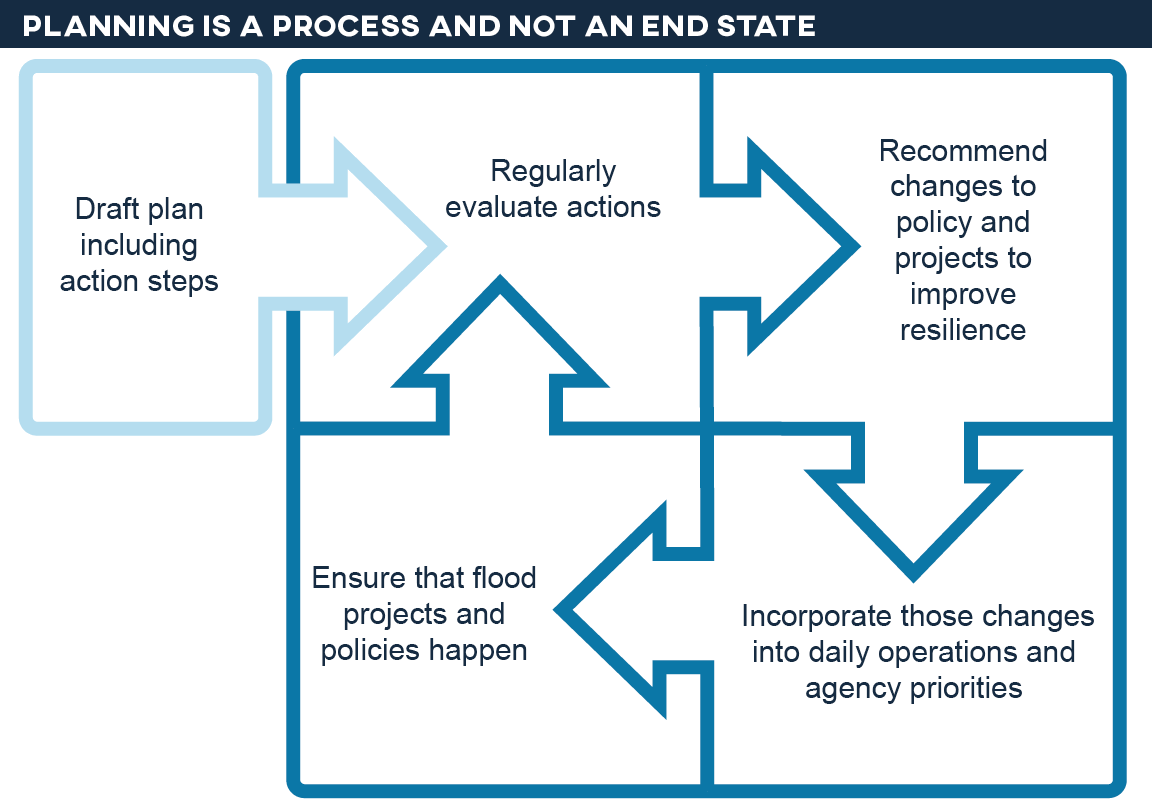
Planning is a process and not an end state. After drafting an initial plan, planners should regularly evaluate actions and recommend changes to policy and projects to improve resilience. Additionally, by incorporating flood-related resilience objectives into daily operations and agency priorities, planners can help ensure flood projects actually happen.
From planning to action
When it comes to planning for resilience, many states do acknowledge the risk of flooding. But too often these plans fail to lead to action, leaving people across the state just as vulnerable to the next disaster. These five recommendations can help planners turn state resilience plans into actionable strategies and, in the process, create safer, more resilient communities.
For more on building resilience at the state level, visit the State Resilience Partnership website. You can also download the Flood Resilience Checklist for State Planners, a one-page PDF with recommendations and considerations for preparing states for flooding and sea level rise.
—
This blog post was co-authored by Gian Tavares, Senior Strategy Associate, and Brandon Pytel, Communications Associate.