
hurricane ian booklets overlayed

Hurricane Ian: Resources for Response & Recovery

As communities across the country deal with the impacts of Hurricane Ian, our thoughts are with those responding and recovering from the storm. To support leaders during the aftermath of Ian, the American Flood Coalition created the below resources.

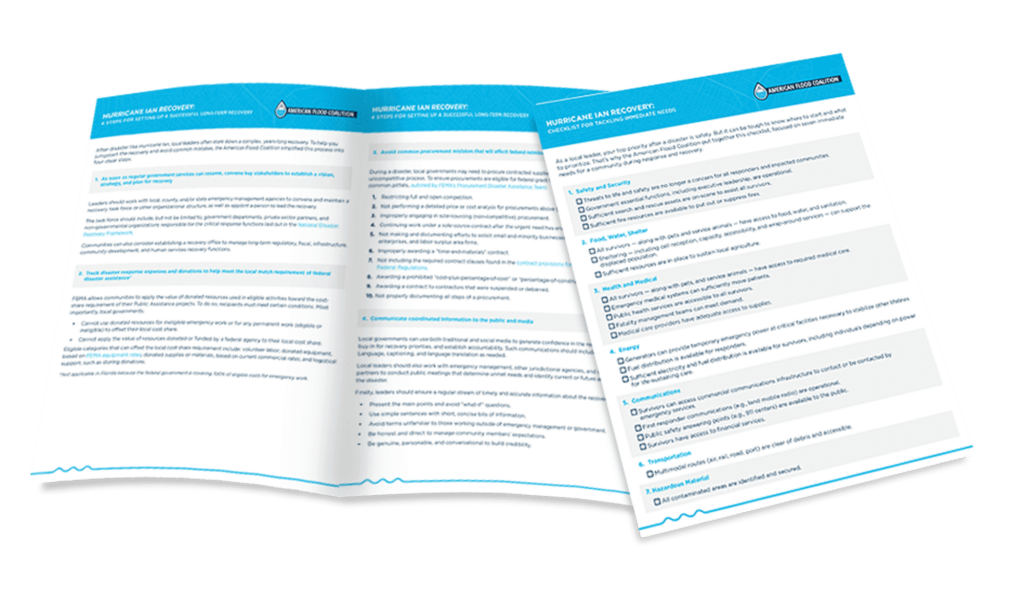
Checklist for Immediate Needs

As a local leader, your top priority after a disaster is safety. But it can be tough to know where to start and what to prioritize. That’s why the American Flood Coalition put together this checklist, focused on seven immediate needs for a community during response and recovery.

4 Steps for Setting up a Long-term Recovery

After disaster like Hurricane Ian, local leaders often stare down a complex, years-long recovery. To help you jumpstart the recovery and avoid common mistakes, the American Flood Coalition simplified this process into four clear steps.

Apply for Public Assistance

As communities deal with the immediate impacts of Hurricane Ian, the Public Assistance program can help shoulder the burden of recovery.

The Public Assistance program helps state, local, territorial, and tribal governments, as well as certain nonprofits, quickly respond to and recover from major disasters or emergencies declared by the president. Governments must submit a Request for Public Assistance within 30 days of the declared disaster, unless otherwise specified.

Florida – DEADLINE EXTENDED

Governments must submit a Request for Public Assistance through the State of Florida’s Public Assistance Web Portal, www.FloridaPA.org. Applications are due by January 6, 2023. Information on which category of Public Assistance your county is eligible for can be found on FEMA’s website.

South Carolina – NEW COUNTIES ELIGIBLE FOR ASSISTANCE

The following seven counties in South Carolina are eligible for all categories of Public Assistance:

  • Berkeley County
  • Charleston County
  • Clarendon County
  • Georgetown County
  • Horry County
  • Jasper County
  • Williamsburg County

Prospective Public Assistance applicants in South Carolina should reach out to the South Carolina Emergency Management Department Recovery Program by phone (803-367-7756) or email (PA@emd.sc.gov) to submit a Request for Public Assistance (RPA) by December 21, 2022.

North Carolina – DEADLINE PASSED

All 100 counties and the Eastern Band of Cherokee Indians of North Carolina are eligible for Public Assistance for Emergency Protective Measures (Category B). Emergency protective measures conducted before, during, and after an incident are eligible if the measures do one of the following:

  • Eliminate or lessen immediate threats to lives, public health, or safety.
  • Eliminate or lessen immediate threats of significant additional damage to improved public or private property in a cost-effective manner.

Prospective Public Assistance applicants in North Carolina can go directly to the FEMA Grants Portal at https://grantee.fema.gov/ to submit a Request for Public Assistance by October 31, 2022.

Facebook
X
LinkedIn

Recent News

Botetourt County, Virginia Deploys an Impact-Based Flood Warning System

Mayor Brad Cavanagh Advances Flood Protection and Economic Stability in Dubuque, Iowa

Mayor Pro Tem Andrea J. Barefield Leads Equitable Flood-Smart Growth in Waco, Texas

Join Our Newsletter

Name(Required)

Help Me Choose

Which characteristics is your community looking for in funding opportunities?

Disaster declaration
A Presidential Disaster Declaration unlocks a suite of federal programs that assist local governments with disaster recovery. This is a good filter for communities included in recent Disaster Declarations related to flooding.
Nature-based solutions
The program has a strong focus on providing assistance to promote a healthy ecosystem as a critical defense against flooding impacts. Eligible activities may include floodplain restoration, environmental stewardship, projects that use natural features to mitigate erosion, and living shorelines.
Encourages public-private partnerships
The program encourages or requires collaboration between government entities and stakeholders, including the private sector, to fund, develop, or implement projects.
Offers rolling deadlines
The program accepts applications on an ongoing basis with no fixed deadline.

Is your project in the planning, design, or construction phase?

Planning
The gathering of data and information regarding the extent and impacts of flooding. Eligible activities may include data acquisition, risk assessment, and environmental analysis.
Design & scoping
Covers pre-construction activities, such as defining project scope, developing technical designs, and securing funding to prepare for implementation.
Construction & implementation
Involves carrying out flood resilience projects, including building infrastructure and deploying solutions to reduce flood risks.

Are you looking for grants, loans, or technical assistance for your project?

Funding (grants)
A monetary award that does not need to be repaid. Many federal grants are reimbursable, meaning recipients must cover project costs upfront and then request reimbursement from the government.
Financing (loans)
A government-issued loan that must be repaid. These loans typically provide funding upfront, helping communities cover project costs before repayment begins.
Technical assistance
Assistance from the government in the form of services — such as project planning, engineering and design support, data analysis, training, capacity building, or collaboration through a cooperative agreement — instead of direct funding.

Some programs provide extra support for specific project types or communities. Do any of these apply to your project?

Small or rural communities
Programs that set aside funding, offer loan forgiveness, or adjust cost share requirements for communities with smaller populations.
Small or low-cost projects
Programs that offer reduced requirements for smaller projects, such as waived cost-sharing or exemptions from benefit-cost analysis.
Regional or watershed focus
Programs that support projects that take a watershed management approach or address flooding at a regional scale, requiring coordination beyond a single town or community.
Tribal communities
Programs that dedicate resources or adjust cost share requirements specifically for tribal governments or organizations.